The Pollution Challenge
Annual outrage has failed to dent Delhi NCR's pollution challenge. If anything it has buried the problem, which is getting worse every year. EPISODE #204
Dear Reader,
A very happy Monday to you.
It is that time of the year, when the only topic dominating discourse in the National Capital Region (NCR) is pollution. It is the season of outrage.
Tragically, nothing comes of this national outrage ever. Even worse, almost everyone who matters knows the problem and how it can be fixed. Instead, all they do is shirk their responsibility and indulge in an endless blame game, assured by public diffidence.
This week I unpack the pollution challenge. The cover picture is a haze of pollution over NCR and is shared by Abel Robinson.
Happy reading.
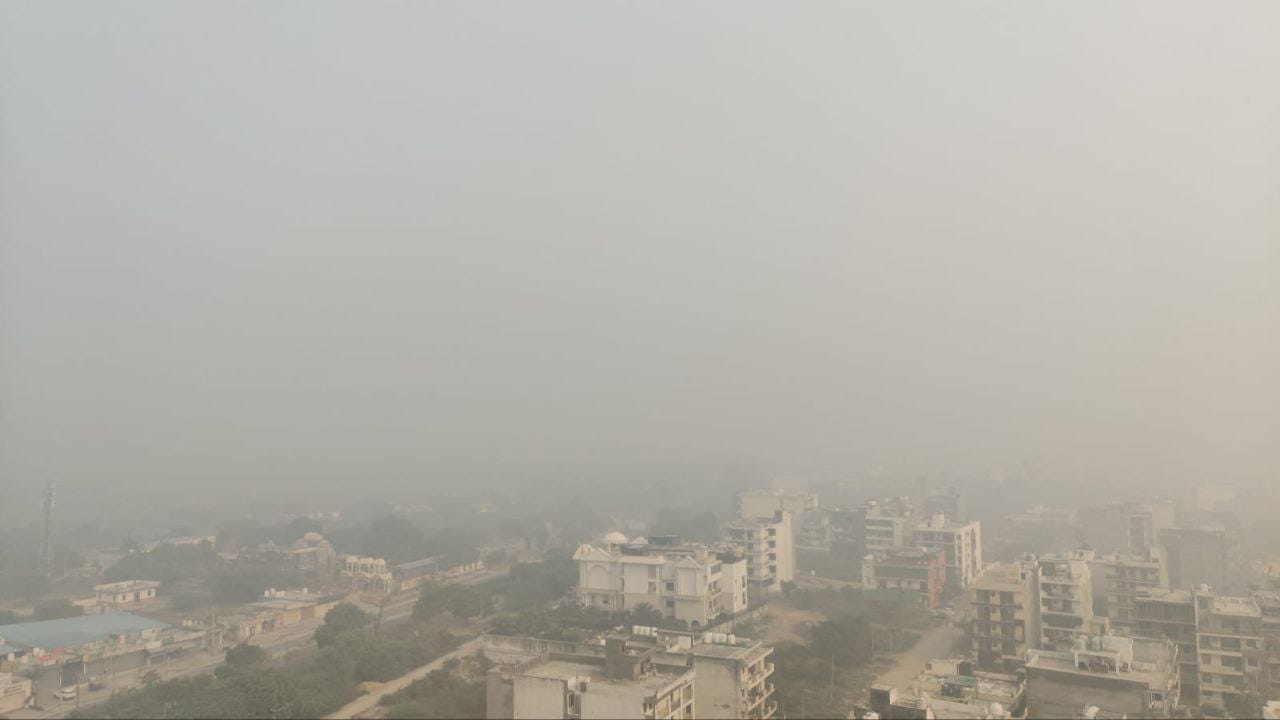
Polluted City
Just like Mumbai has a moniker, Maximum City, Delhi too will have one of its own. Sooner if not later: Polluted City.
I am not being facetious. According to the Central Pollution Control Board (CPCB), the number of days with poor air quality, wherein the Air Quality Index is higher than 300, has progressively grown in the last three years in Delhi. Between October and February, the number of bad air quality days was 67 in 2021-22, 73 in 2022-23 and 92 in 2023-24. In other words, three out of five months in winter are overcome by hazardous pollution.
Going by the ongoing outrage—manifest in national media and blame game among politicians—it is obvious that Delhi’s pollution problem is no national secret. Yet, every year we live out this dangerous environment in Delhi in particular and the National Capital Region (NCR) in general.
The Business of Outrage
Six years ago, I had flagged Delhi’s pollution dilemma in my weekly column in Mint. At that time I wrote:
“As if on cue, it (onset of pollution) sets off an annual ritual wherein the city’s political incumbent and their counterparts from the adjoining states engage in a round of vitriolic mutual blame game; social media and drawing rooms abound with moral outrage; and the pollution mitigation industry rakes it in as citizens, at least those who can afford it, rush to acquire air purifiers and personal air pollution masks.
By February-March when nature ordains a reordering of atmospheric conditions, pollution will recede, public venting will cease and Delhi will limp back to normalcy—if one can call it that. And all of us would have moved on to the next news cycle of outrage.
This is precisely the problem with the discourse on fighting pollution, not just in Delhi, but across the country. As famously coined by Shakespeare in Macbeth, ‘a tale told by an idiot, full of sound and fury, signifying nothing’”.
Sadly, six years later, as I sit down to review this vexing problem, nothing has changed. The outrage continues.
In fact, I have come to believe that this is an organised charade which ensures incumbent politicians play out this annual cycle and avoid addressing the challenge. Media feeds this frenzy as it gets them the seasonal eyeballs—the metric for moolah.
Pollution Facts
Pollution is considered a silent killer.
This is because of a spike in the presence of tiny particulate matter known as PM2.5 in the air between October and February every year. For most of these months the level of PM2.5 is classified as hazardous. The size of the particulate matter is 2.5 microns and can hence easily lodge in an individual’s respiratory tract.
A study published in Nature Communications in April this year, makes frightening claims about pollution linked fatalities.
“It is estimated that exposure to high levels of ambient PM (particulate matter) is responsible for 0.6–1.3 million premature deaths in India each year, along with 14–33 million years of life lost (YLL).
Without any intervention, these numbers are expected to increase by 50% by 2030.”
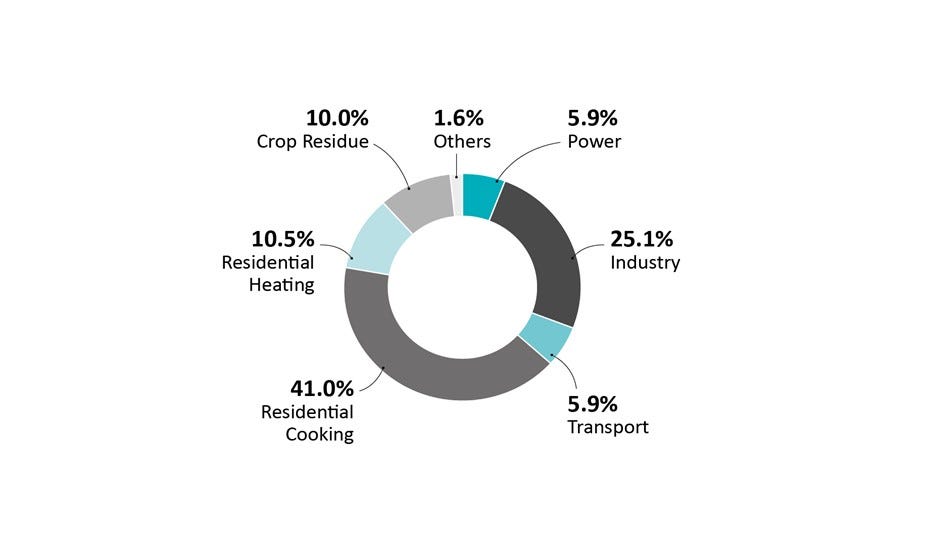
According to a study conducted by iForest, a Delhi-based environment advocacy outfit, 60% of PM2.5 can be traced to biomass burning, while industry accounts for 25%, and transport contributes around 6%—and yet we see automobiles being identified as the biggest villains. Check out the graphic above.
An Action Plan
One factor, often ignored, is that Delhi is shaped like a saucer. As a result, the absence of cross-winds will ensure that tonnes of PM2.5 will stay suspended in the air above us. The onset of winter and the cold air it brings with it traps these particles, ensures that this is not dissipated into the atmosphere.
And this is true for most of the Indo-Gangetic plain. Which is why you see a pall of pollution along this stretch upto Kolkata in satellite photographs.
As I said earlier, the experts have already weighed in on the problem and submitted their action plan. The control options submitted to the Delhi government in the ‘Comprehensive Study on Air Pollution and Green House Gases (GHGs) in Delhi include:
Ban burning of Municipal Solid Waste (MSW) and ensure timely collection, disposal;
Control road dust with the construction of better quality roads (If anything, Delhi’s roads have gone from bad to worse in the last decade); complement this with frequent sweeping and watering of roads;
Get 9,000 hotels/restaurants to replace their coal-fired ovens (to cook our delicious tandoor food) with gas/electricity ovens;
Reduce sulfates, nitrates emissions from the 13 thermal power plants with a capacity of over 11,000 MW in the 300 km radius of Delhi;
Curb farm fires;
Implement strict rules already in place to contain dust dissipation from construction activity.
These suggestions are neither complex nor difficult to implement. Yet, the authorities struggle to do so.
Yes, some of the steps require coordination with neighbouring states. Politically these states may be at odds, but pollution binds people through their common suffering—ask people living in Noida or Gurugram. Unfortunate electoral diffidence to the problem of pollution ensures that politicians are not held accountable.
It is obvious that the frontline warrior against pollution has to be the municipal agency. Most items in the check-list shared in the above mentioned report are under the direct purview of the municipality.
I will close with a quote from Chandra Bhushan, CEO of iForest. This is from my podcast conversation with him in 2020. The views are still relevant.
“If you see in Delhi today, the weakest institution is municipalities.
Okay, we keep talking about what state government is doing or what the union government is doing, but the fact of the matter is, there is dust on road. It is the responsibility of municipalities to make sure dust is not there, or greenery is there, or the construction is done well, or the waste is not burned. These are municipal responsibilities.
You know, municipalities were called public health agencies. Go back a little and you will know that they were called public health agencies.
Our municipalities are not doing their job, and somehow we are centralizing everything in this country, and I find this extremely problematic.”
And then added:
“So I think the fundamental problem that that this country faces today is that we are growing without strengthening local institutions to actually tackle that problem. No country in the world has done that.”
Recommended Viewing
Sharing the latest episode of Capital Calculus.
In the few weeks since Donald Trump pulled off an audacious win in the just concluded US Presidential election, there is one development catching everyone’s eye: The Rise and Rise of Elon Musk, the maverick owner of X (formerly Twitter), Tesla and Starlink. He is already being described as “The First Buddy”.
The big question is whether this extraordinary influence in Trump 2.0 will shape US foreign policy, especially when it comes to business decisions involving companies from the Musk stable. India too could be caught in this crossfire, given that Tesla and Starlink have queued up for investment into the country. Musk has been demanding special terms, but the Indian government hasn’t blinked.
To answer these questions and more I spoke to Pradeep Mehta, Secretary General of CUTS.
Sharing the link below:
Till we meet again next week, stay safe.
Thank You!
Finally, a big shoutout to Gautam and Premasundaran for your informed responses, kind appreciation and amplification of last week’s column and to Sumod for flagging an error. Once again, grateful for the conversation initiated by all readers. Gratitude to all those who responded on Twitter (X) and Linkedin.
Unfortunately, Twitter has disabled amplification of Substack links—perils of social media monopolies operating in a walled garden framework. I will be grateful therefore if you could spread the word. Nothing to beat the word of mouth.
Reader participation and amplification is key to growing this newsletter community. And, many thanks to readers who hit the like button😊.
A very articulated write up Anil, starting from the annual blame game routine, to the causes and suggested solutions. The reduction of pollution from large quantities of food being cooked in commercial establishments and provision of more cooking gas connections to the poorer sections of society would be big steps for the reduction of pollution. Further, the immediate imposition of fines, like in traffic rules violation, could be imposed on lighting bonfires. The opening of more CNG pump stations will definitely encourage more people to install CNG kits in their petrol vehicles. More trees and water sprinklers have to be planted/placed all over the city and crowded suburbs. Thank you Anil for an excellent article.