Shared Enemies to Shared Vulnerabilities
As wars disrupt energy and trade routes, countries are pivoting to partnerships designed not to project power, but to survive growing incidence of systemic shocks. Episode #280

Dear Reader,
A very Happy Monday and the week ahead,
Little under a fortnight ago, India and the United Arab Emirates (UAE) inked an agreement, which among other things, secured a strategic petroleum arrangement between the two sovereign countries. Go beyond the headline and you will see something profound. A distinct pattern that is the metaphor for defence in this new geopolitical era.
Especially, if you keep in mind that this is not an isolated deal. Other countries, regions too have inked similar deals—like Europe’s LNG pivot after the Russia-Ukraine war, US-Japan-Netherlands semiconductor alliance, US inspired alliance for green minerals, BRICS push for alternative payment systems, GCC-India-Africa food corridor and undersea cable partnerships.
Clearly, as regional conflicts together with fragmenting geopolitics rapidly reshape global energy and trade routes, countries are aligning less around shared enemies and more around shared vulnerabilities tied to supply chains, capital and resilience—also the focus of this week’s newsletter.
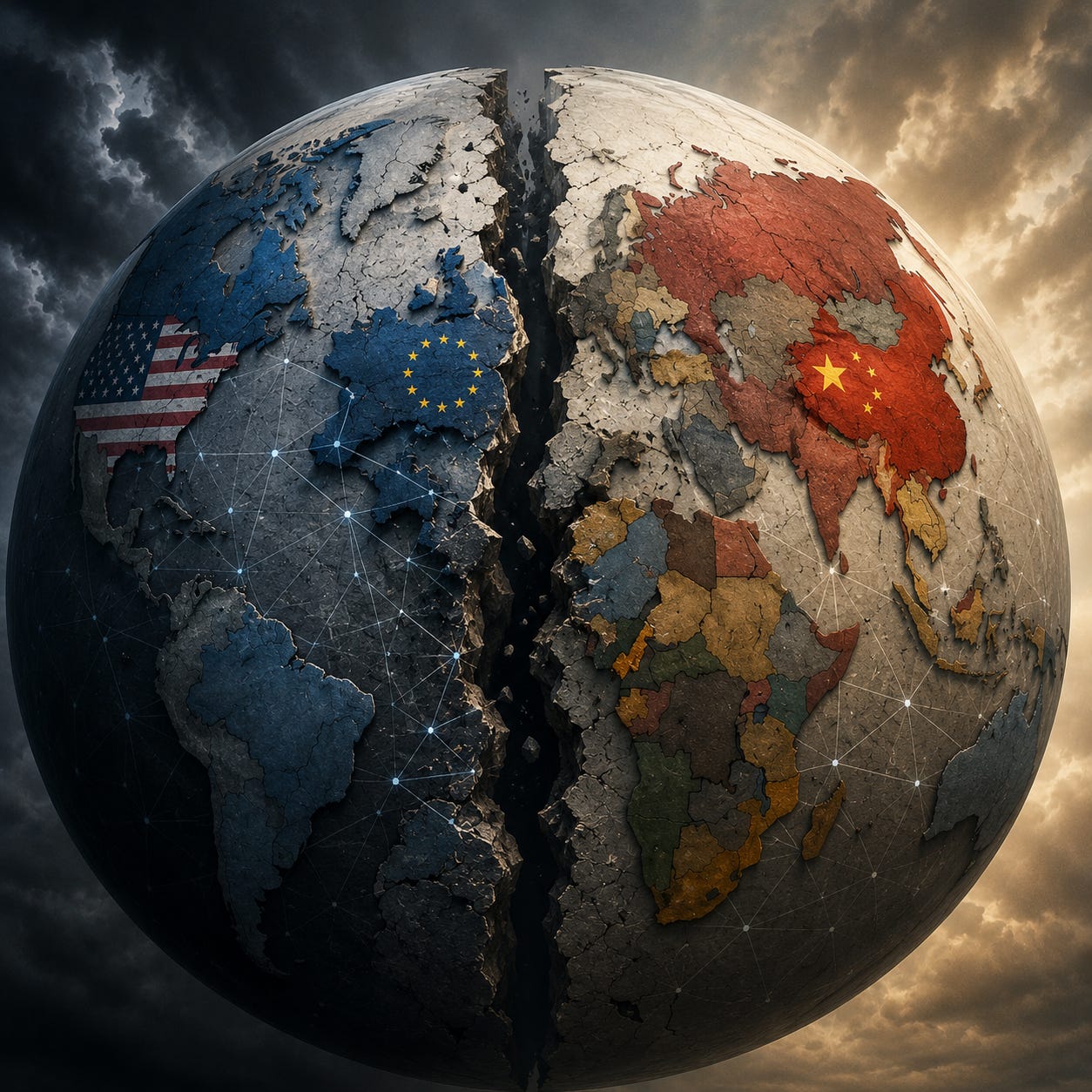
The cover picture is an AI generated image of a world that is being torn apart by fragmenting geopolitics.
Happy reading.
The New Risk Mantra
Taking up from my introduction, let me take you back to the recent agreement between the United Arab Emirates (UAE) and India.
Under the agreement, the UAE will store, finance and retain ownership of up to 30 million barrels of crude oil in India’s strategic petroleum reserves. Besides the existing storage at Mangalore, the deal will look to create new storage opportunities at Vishakhapatnam and Chandikol.
In return, India gets first dibs to this strategic reserve during emergencies—take for example, the energy shock arising in the aftermath of the ongoing conflict in West Asia.
Further, the agreement also explores potential crude oil storage in Fujairah, UAE—which bypasses the choke point at the Strait of Hormuz—alongside potential LNG and LPG storage opportunities in India. In the process, the UAE has also committed itself to be reliable long term LPG supplier to India.
On paper, this is a practical and mutually beneficial energy arrangement between the two countries. A win-win, especially in the inclement geopolitical circumstances prevailing in the world today.
In substance, however, it is so much more. It is a strategy to de-risk both countries in a world growing more fragmented, volatile, and yet remaining interconnected at the same time.
Along with similar deals inked between other countries and regions, they signal the evolution of a new global risk architecture. One which signals the transition from an efficiency-driven globalisation to one developed on the foundation of resilience-driven interdependence.
Shock Proofing Geopolitics
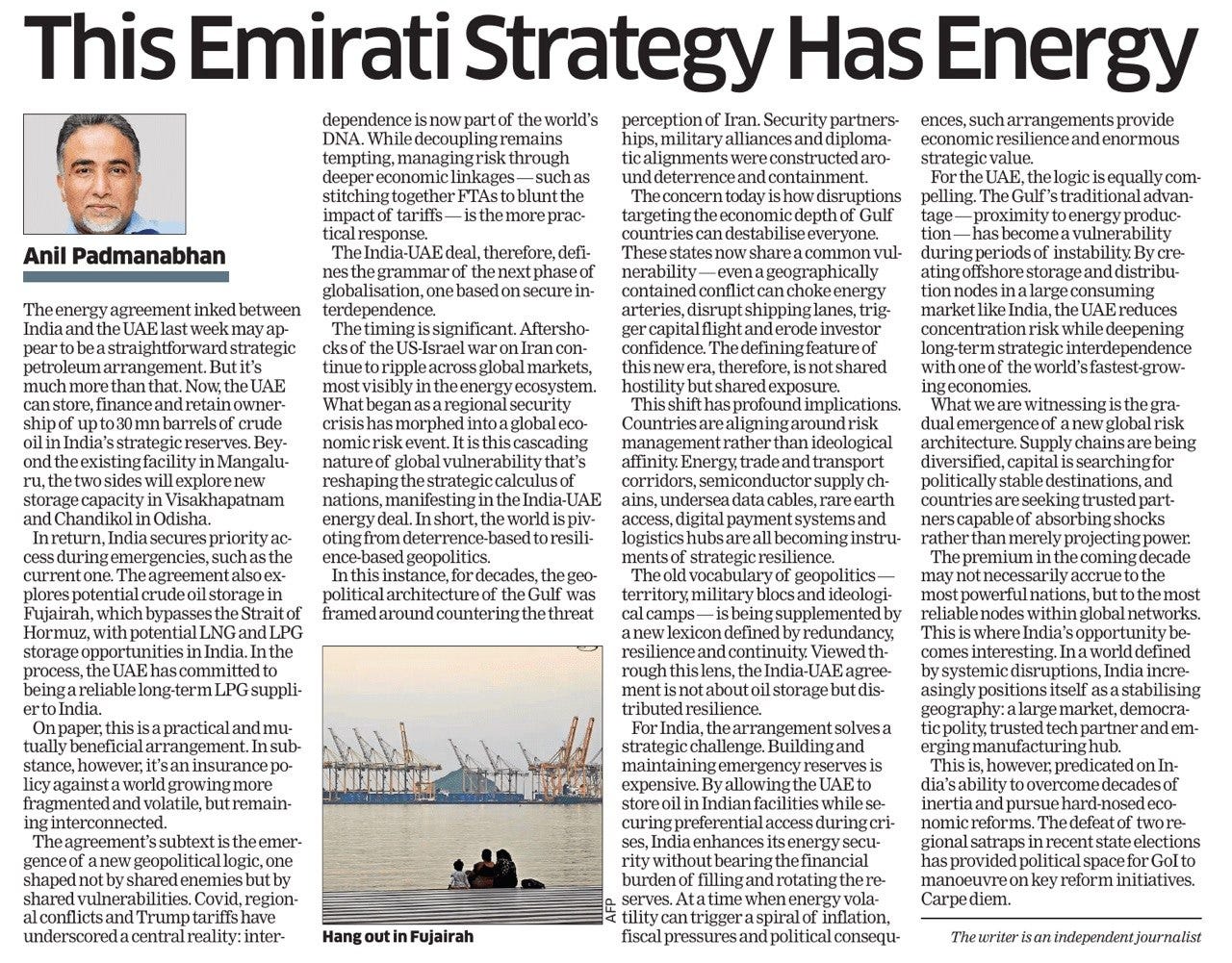
Last week I wrote a version of this argument for the Economic Times—besides the link, I have also shared the screen grab above.
It sets out the broad contours of my argument, which is basically that the world is moving from deterrence-based geopolitics to resilience-based geopolitics.
“What we are witnessing is the gradual emergence of a new global risk architecture. Supply chains are being diversified, capital is searching for politically stable destinations, and countries are seeking trusted partners capable of absorbing shocks rather than merely projecting power.
The premium in the coming decade may not necessarily accrue to the most powerful nations, but to the most reliable nodes within global networks.”
The onset of the once-in-a-century covid-19 pandemic in 2020, accelerated this makeover. It showed the world, how superpowers were not above leveraging a health disaster to achieve geopolitical ends.
Accordingly, this strategic pivot is visible in deals undertaken across energy, technology, logistics, semiconductors, finance and even digital infrastructure. Sharing a dozen recent examples to reinforce the thesis I have put forward.
India–UAE Strategic Oil Storage Agreement
This transition is:
not military alignment,
but energy continuity and supply resilience.
The logic: How do we protect flows during disruption.
Europe’s LNG Pivot After the Russia-Ukraine War
European Union-Qatar-Norway-United States
After dependence on Russian gas became a strategic liability:
Europe diversified LNG sources,
expanded floating terminals,
built energy redundancy.
Not because these countries shared ideology—but because they shared vulnerability to energy disruption.
3. India–Middle East-Europe (IMEC) Corridor
IMEC is often presented as a geopolitical counterweight to China. But equally important:
it is a resilience corridor,
designed to diversify trade routes,
reduce chokepoint exposure,
and, build supply chain redundancy.
It reflects a world seeking “trusted pathways.”
4. The US-Japan-Netherlands Semiconductor Alliance
Restrictions on advanced chip exports to China are not just about rivalry.
They reflect shared anxiety over:technology dependence,
supply concentration,
strategic chokepoints.
Semiconductors are now treated like energy security assets.
5. India-US Semiconductor and Trusted Tech Partnerships
The emerging India-US technology framework is increasingly built around:
resilient supply chains,
trusted manufacturing,
secure digital ecosystems.
Again, not merely alliance-building, but vulnerability management.
6. “Friend-Shoring” Supply Chains: China+
Global firms are diversifying away from concentrated manufacturing dependence on China.
The driver:
pandemic shocks,
shipping disruptions,
sanctions risk,
geopolitical unpredictability.
7. Red Sea Shipping Diversification
Red Sea disruptions triggered:
rerouting around Africa,
new insurance structures,
alternative logistics planning.
Countries and corporations discovered: globalisation without redundancy is fragility.
8. India-France-UAE Maritime Cooperation
Increasingly focused on:
maritime domain awareness,
sea lane stability,
logistics continuity.
The emphasis is less on warfare and more on keeping systems functional.
9. BRICS Push for Alternative Payment Systems
This is partly ideological—but also deeply risk-driven.
Countries fear:
sanctions exposure,
dollar payment disruption,
financial weaponisation.
The goal is resilience against systemic financial shocks.
10. Gulf Sovereign Wealth Funds Expanding Into India
These investments increasingly reflect:
long-term diversification,
demographic hedging,
strategic economic positioning.
Capital today is seeking:
stability,
scale,
political reliability.
11. Undersea Cable Partnerships
Countries see strategic assets in:
sub-sea Internet cables,
cloud infrastructure,
data routing
The concern:
sabotage,
surveillance,
cyber disruption.
Connectivity itself has become a vulnerability.
12. UAE Investments in Food Corridors
The logic:
climate shocks,
water scarcity,
food supply fragility.
Food security is now geopolitical security.
Clearly, the arrangements listed above overlap over a range of geopolitically vital sectors like energy, chips, logistics, payments, food and digital infrastructure.
Strikingly, the common underlying logic is no longer necessarily about who “threatens us”. Instead, it is about “what can disrupt us”: the basis for the shared vulnerability framework.
In the near future this will serve as the operating logic of the global system. They point toward a larger structural transformation: wherein, the world is moving from deterrence-based geopolitics to resilience-based geopolitics.
In future, power is no longer defined solely by military capability or ideological influence. Increasingly, it will be defined by the ability to absorb shocks, maintain continuity and secure trusted networks.
This is the emerging grammar of the global system: not hyper-globalisation, but secure interdependence. In this era, the countries that matter most may not necessarily be the most powerful. They may be the ones most capable of building resilience together.
Indeed, this opens up a great opportunity for connector countries, middle powers like UAE, India, Vietnam, Mexico, Indonesia, Saudi Arabia, Turkey, and so on.
While the “Melody” moment from last week may have grabbed national attention in India, it is this mantra of secure-interdependence in a fragmenting world that has driven India’s foreign policy agenda in recent years, especially in the aftermath of the pandemic.
Recommended Viewing
Sharing the latest episode of Capital Calculus.
Recently, India undertook one of the most significant upgrades to its economic measurement system in decades. The rebasing of GDP and CPI may appear technical on the surface—but beneath it lies a much bigger story: India’s economy has structurally transformed.
The weight of food in the inflation basket has fallen sharply. Services and discretionary consumption are playing a much larger role. Digital data systems, GST integration, real-time labour surveys, and improved tracking of the informal economy are reshaping how India measures growth and inflation.
In this episode of Capital Calculus, I spoke with Saurabh Garg, Secretary at the Ministry of Statistics and Programme Implementation (MoSPI), on India’s evolving statistical architecture, the rebasing of GDP and CPI, the rise of services and consumption, and why credible real-time data is becoming central to India’s growth story.
Key Takeaways:
• Why India rebased GDP and CPI
• The sharp fall in food’s weight in inflation
• How GST and digital systems are improving economic measurement
• Why services and discretionary consumption matter more now
• How India is capturing the informal economy more effectively
• Why real-time data matters for the RBI and policymakers
• The growing importance of credibility and transparency in India’s statistical system
• What this means for investors, markets, and India’s global economic positioning
Do watch the entire conversation. Sharing the link below.
Till we meet again next week, stay safe.
Thank You!
Finally, a big shoutout to Gautam and everyone else for their informed response, kind appreciation and amplification of last week’s column. Once again, grateful for the conversation initiated by all readers. Gratitude to all those who responded on X (formerly, Twitter) and Linkedin.
Presuming you like it, I will be grateful if you could spread the word about this newsletter. Nothing to beat the word of mouth. Reader participation and amplification is key to growing this newsletter community.
And, many thanks to readers who hit the like button😊.
Thank you Anil for your comprehensive analysis, which is an eyeopener to what is currently happening. The Saudi Pakistan defence agreement, during the Israeli occupation of Gaza, could possibly be the logical reason for the UAE India tie up; in the backdrop to the Saudi UAE fallout and the latter exiting the Saudi dominated OPEC. Although there is no defence pact, similar to the Pakistani pact with Saudi Arabia, the undertones of the arrangement, does imply a tacit support for the UAE, in defence of their sovereign rights. India has been quick to issue disapproval of attacks on UAE by Iran, eversince the agreement. India has made strategic agreements with Canada, EU and Russia has always been the trusted friend. In future similar new agreements could be arrived at in QUAD and amongst BRICS nations. We are now welcoming a truly multi polar world, that is not ready to accept global bullying by any power, whether it is militarily or critical resources. Thank you for sharing a new allingnment of interest oriented alliances.
Dear Gautam,
Thank you for your comments. Much appreciated.
You have summed it up so well: India's strategy of multi-alignment. This is the only way it can de-risk itself in a world were risk has pivoted from shared-enemies to shared-vulnerabilities.
Look forward to your continued participation.
Best
Anil