POTUS Blinks
President Donald Trump’s decision to walk back tariffs on India is a welcome growth boost, but also raises a harder question: is India ready to compete globally? Episode #265

Dear Reader,
A very Happy Monday to you.
Last week, President Donald Trump, true to style, took to social media to announce an end to the impasse with India on trade. He posted that the United States will lower tariffs on Indian exports to 18%—from the prevailing 50%.
The timing of President Trump’s climb down was significant. It came just 24 hours after the Union government presented the Union Budget for 2026-27 and little over a week after the European Union and India inked a landmark Free Trade Agreement that will extend to 2 billion people.
Though unexpected, it is a welcome move that relieves considerable geopolitical pressure on India and provides a tailwind to economic growth in 2026-27. Yet, it also asks whether India is prepared to globally compete—the focus of this week’s newsletter.
Undoubtedly, it was a great win for Indian diplomacy, which took the pragmatic route when dealing with a hegemon and maintained its dignity despite frequent verbal provocations from the President.
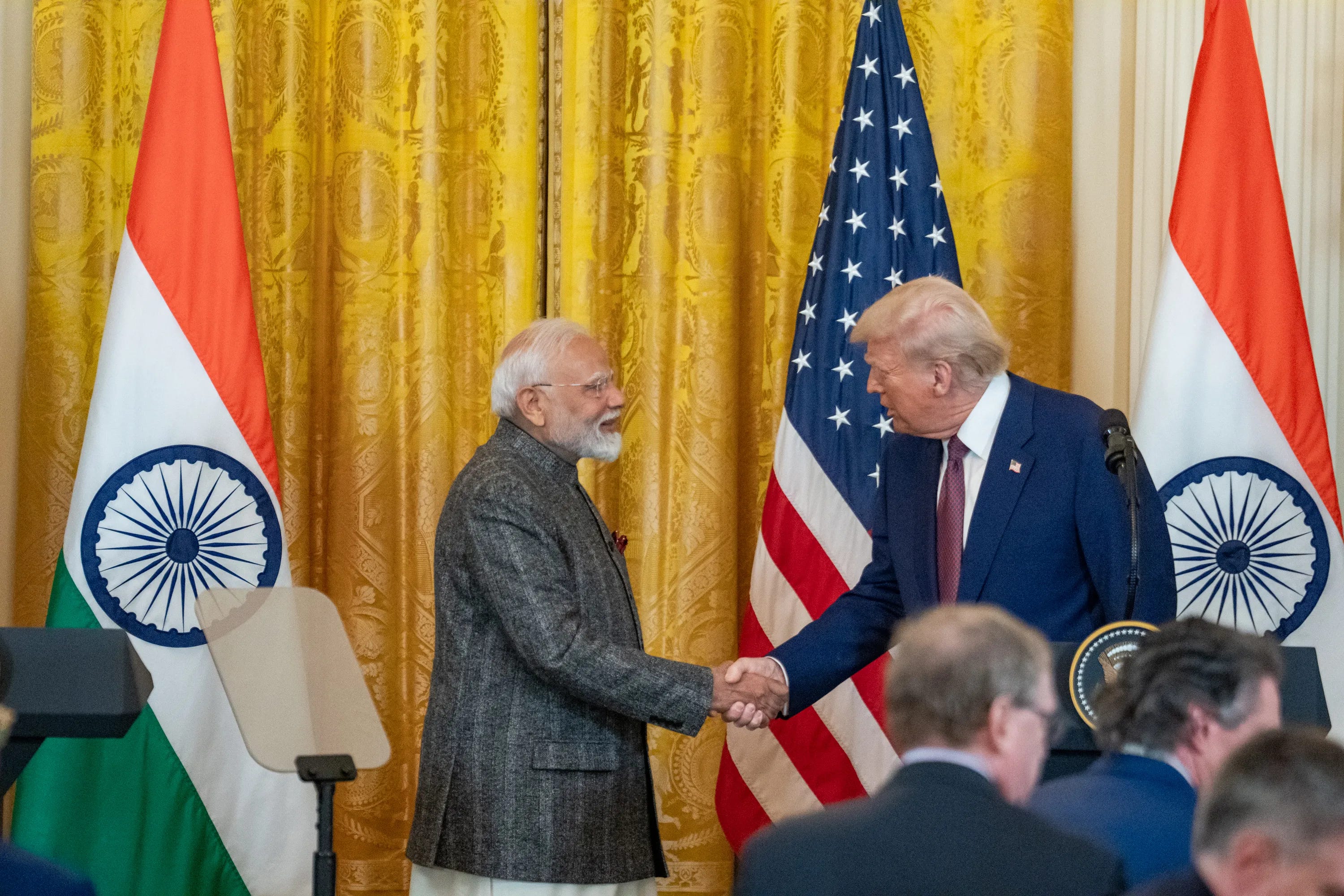
The cover picture is sourced from the White House. It was taken during President Trump’s meeting with Prime Minister Narendra Modi last year.
Happy reading.
TanTrumps
True to his impulsive style, President Donald Trump flipped the script on India last week. After raining on India with acerbic comments—remember “India is a dead economy”—for the last six months, the President took to Truth Social (his preferred social media platform) to declare an end to the trade impasse.
A few days later, both sides issued a joint statement on what is a preliminary deal to an interim agreement—which in turn, precedes the Bilateral Trade Agreement (BTA), that both sides agreed to pursue after the summit meeting between President Trump and Prime Minister Narendra Modi in the White House last March.
There is a barrage of spin and counter-spin being flung around and hence the takeaways can be hugely confusing. IMHO there is no binary: good or bad. Instead, it is about whether India succeeded in minimising the damage to the domestic economy in the unpredictable world of Trumpnomics.
Accordingly, the big takeaway is that tariffs on Indian exports have dropped from a knee-capping 50% to a manageable 18%—especially when compared to India’s trade competitors. This tariff will extend to about 55% of Indian exports to the US. As a result, the country’s labour intensive export industries like textiles—several of which have shut down—can get a second lease of life.
And for those getting into a flap over minutiae, wake up and smell the coffee: we live in an unfair world. Especially one in which the world’s largest economy—measuring a staggering $29 trillion—has decided to throwout all the existing rules and weaponise its size to bully other nations into submission.
This is not to justify what the United States is doing. Instead, it is about accepting the harsh reality and adopting a pragmatic strategy that mitigates the fallout from this unfairness. Grandstanding is the luxury of armchair analysts and out-of-favour politicians.
Check out the graphic below for a reality check on India’s options.
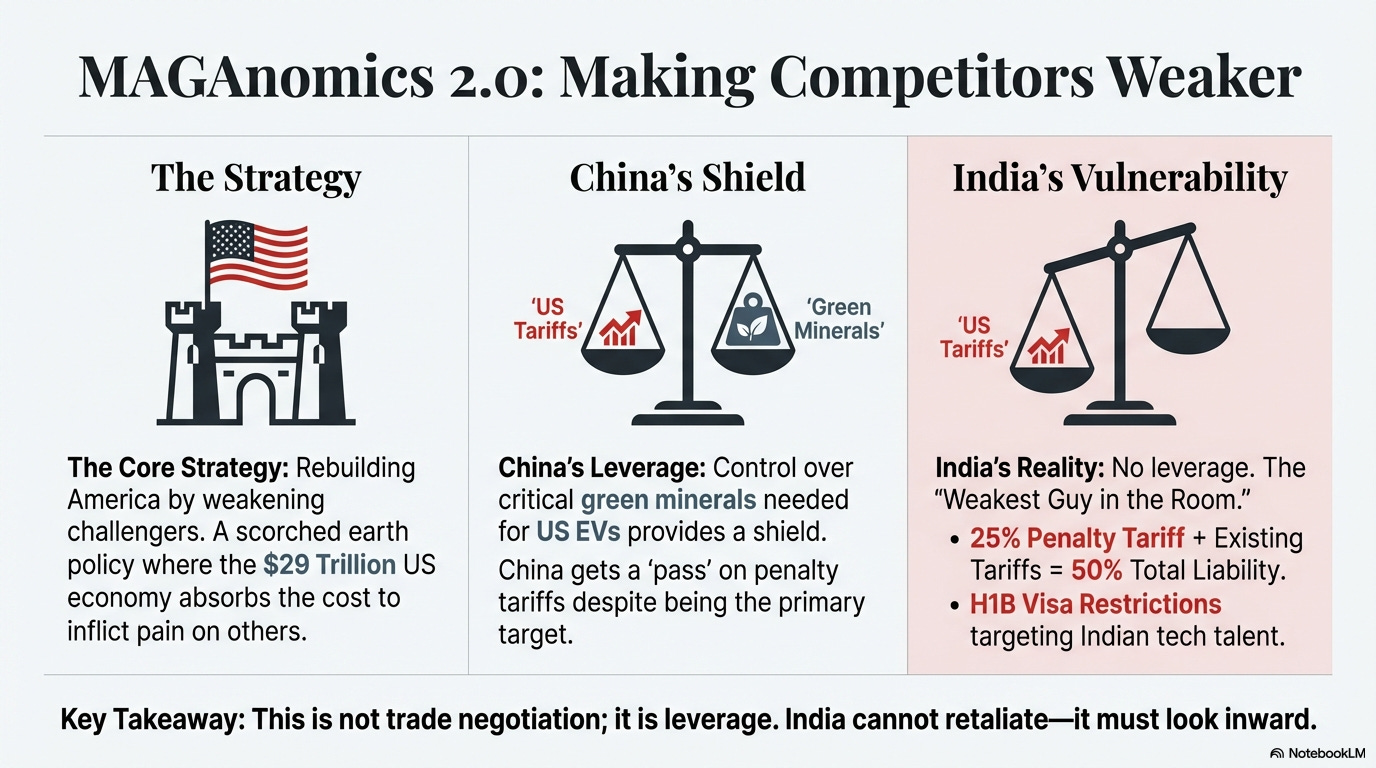
The above is true, especially for India that has committed itself to an audacious objective of becoming a developed economy by 2047—for which it requires access to investments and technology, both of which the US has in dollops.
Mohan Kumar, a former Indian diplomat with a phenomenal understanding of geopolitics, frames this dilemma best. According to him, given the altered geopolitics, every country is facing a trifecta: global interdependence, economic heft and strategic autonomy.
He then argues that barring the United States and China—the two largest economies in the world—every other country can at best achieve two, not all three.
The fact that India, without any big cards to deal, has been able to hold its own for so long against such a powerful and unpredictable country like the United States is a miracle. I would say it has been able to leverage its potential as the next big growth economy to extract a tariff concession for now.
The bottomline is that by inking nine trade deals (including the one with the US), all developed countries, India has created an enviable trade space for itself.
However, to exploit this hard earned opportunity, India has to double down and become more competitive—especially in reducing the friction, particularly red tape and administrative corruption, in the Indian economy.
The question is whether India can pull this off?
Fact Of Friction
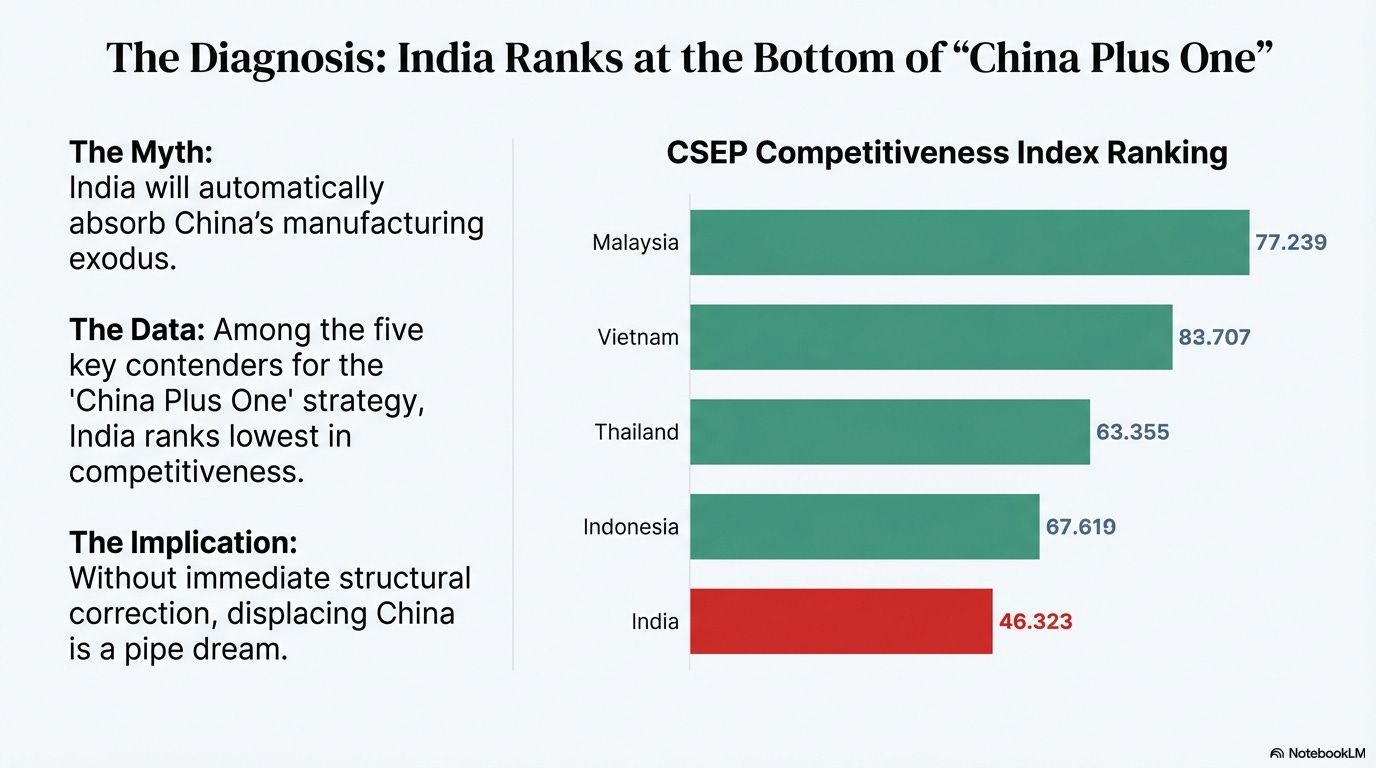
I would like to revisit a graphic used recently by me. It is based on a study published by the Centre for Social and Economic Progress (CSEP), a Delhi-based think tank, and captures the lack of competitiveness of the Indian economy.
To be sure, this lack of competitiveness is not true for every sector of the Indian economy, especially services. But then, services, unlike manufacturing, can mostly bypass the friction generated by regulatory cholesterol associated with the basic factors of production: land, labour and capital.
The latest conversation on StratNews Global shared at the end of the newsletter is a conversation with the author of this report. We also critically examined India’s options given the present state of geopolitics.
The competitiveness index developed by CSEP compares India and its peers, including Malaysia, Vietnam, Thailand and Indonesia—all of whom are the China-plus-one countries. It is structured around six main pillars, all of which have an equal weight:
Factor conditions;
Demand conditions;
Supporting and related industries;
Firm strategy and rivalry;
Regulatory quality;
Global trade policy.
The scoring is shocking but not surprising: India ranks at the bottom, even individually, with the exception of regulatory quality and demand conditions.
The scores are a rude wake-up call about the country’s lack of competitiveness, stemming from the high levels of friction in the economy—imagine an athlete, strapped with 20kg weights on each leg, attempting to compete in a global championship.
For instance, on firm strategy and rivalry, India’s score is in single digits, suggesting that there is high concentration and hence little or no competition. If you look at airlines and telecom—the fastest growing sectors—it is is a duopoly.
The consequences of this were made apparent recently when Indigo sought to browbeat the government over a regulatory face-off and grounded its aircraft—completely disrupting air travel.
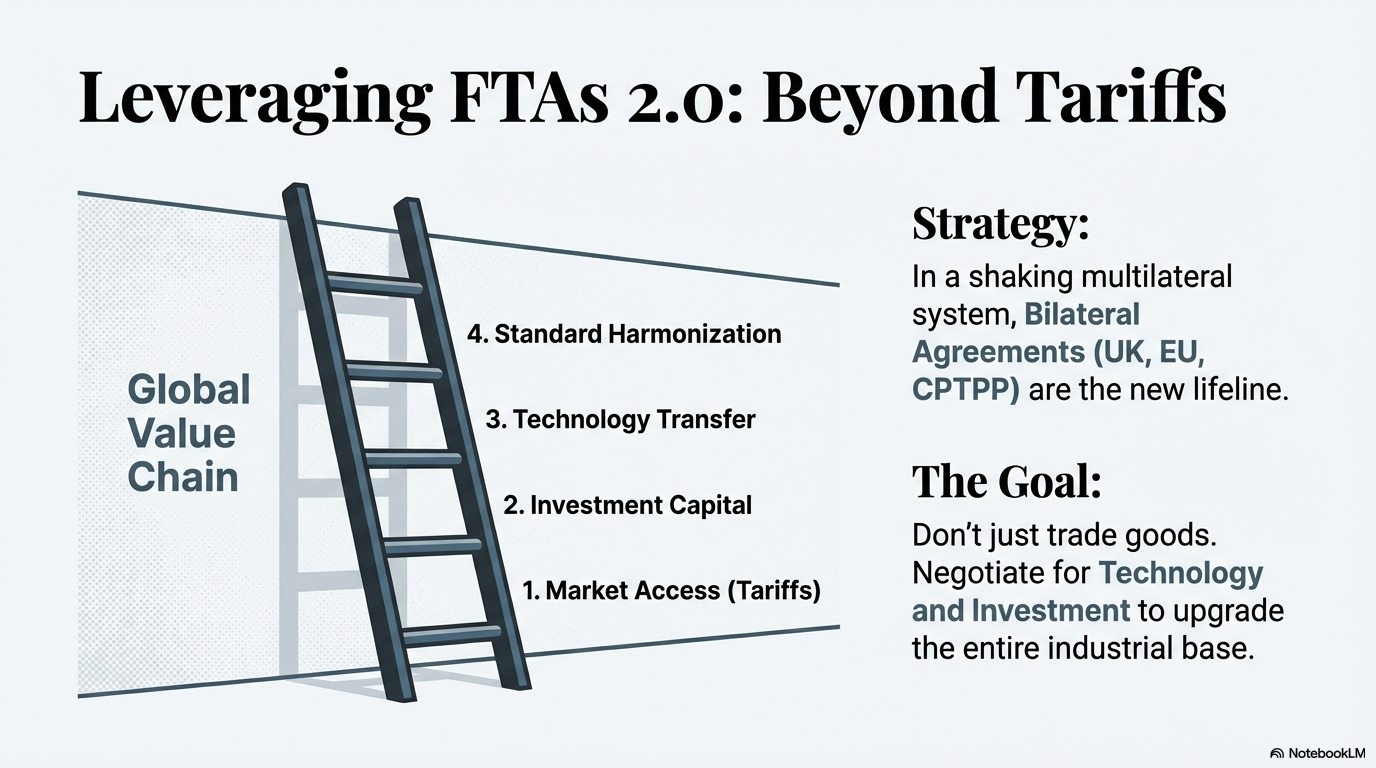
Worse, this missing middle in India’s industrial structure is a barrier for India to integrate into Global Value Chains (GVCs)—an opportunity that has been created with the slew of trade deals India has inked so far with developed nations.
The impact of this structural gap manifests in critical ways:
Inability to Achieve Economies of Scale: Integration into global markets requires significant scale to meet international demand and maintain cost-efficiency. However, Indian labour laws—only recently re-tuned—provided perverse incentives for firms to remain small (under 100 workers) to avoid regulatory cholesterol.
High Input Prices: The concentration at the top of the industrial spectrum results in a few large companies possessing disproportionate pricing power. Because they control upstream production and are shielded by high import tariffs—something that will be dialled down once the FTAs kick-in—they can charge higher prices for inputs. In turn, this makes it difficult for downstream manufacturers to remain competitive.
Stagnation in Low-Value-Added Activities: Due to a lack of scale and resources, Indian firms struggle to invest in Research and Development (R&D) and innovation. Consequently, India remains largely stuck in the assembly stage of production—instead of manufacturing high-tech, high-value-added products from scratch.
Misalignment with Global Demand: The assurance of a large domestic market, combined with the lack of mid-sized firms capable of pivoting to international trends, leads to a disconnect with global demand.
For instance, while the global market has moved toward synthetic garments, the Indian textile industry remains focused on cotton-based products for domestic use, causing it to lose GVC market share to competitors like Bangladesh and Vietnam.
Barriers to Technology Flow: The missing middle means there is a lack of competitive, mid-sized firms that can act as funnels for the absorption of advanced technologies often transferred through FTAs.
As a result, India will continue to struggle to bridge the competitiveness gaps, unless it fixes these gaps.
IMHO, the recent FTAs together with the fresh impetus on structural and process reforms—even at the level of some states—is providing the basis for a reset in India’s approach to global trade.
Next Steps
The good news is that India’s cup is half-full and not half-empty.
It has, in the last decade, reclaimed enviable macroeconomic stability and demonstrated resilience to withstand back-to-back global shocks beginning with the covid-19 pandemic in 2020.
The growing appetite for reforms suggest that status quo, which has strangled enterprise for the last seven decades, may be changing.
More importantly, India has thrown down the gauntlet by boldly entering into a raft of FTAs with eight developed countries—the ninth, with the United States, is on course. While it exposes India’s weak flanks—long sheltered by high tariffs—it also provides a terrific opportunity for the country to integrate itself into GVCs and access much needed investment and technology.
Indeed, like I wrote last Monday in the context of the EU-India deal, it is a “mother-of-all tests” as much as it is a “mother-of-all-deals”. Probably, the biggest test faced by modern India.
Carpe diem, India?
Recommended Viewing
Sharing the latest episode of Capital Calculus. Please note that Capital Calculus has moved to a new home, Stratnewsglobal.tech, within StratNews Global. This relocation will take a bit of getting used to.
In a surprise move, the United States announced a steep reduction in tariffs on Indian exports—considerably easing geopolitical pressure and creating a new opening for India’s global trade ambitions. At the same time, momentum is building around the EU–India Free Trade Agreement (FTA), raising a tougher and more consequential question: Is India truly ready to compete globally?
I spoke to Prerna Prabhakar of the Centre for Social and Economic Progress (CSEP), to help unpack this and a range of other vexing questions:
What this means for India’s export strategy;
The real stakes of the EU–India FTA;
Whether Indian industry is prepared for global competition;
The structural constraints holding India back;
How geopolitics is reshaping global trade alliances?
As the world makes space for India in supply chains and trade frameworks, the question is no longer about opportunity—but about execution. Will India, once again, flatter to disappoint, or realise its trade ambitions?
Do watch the full conversation. Sharing the link below.
Till we meet again next week, stay safe.
Thank You!
Finally, a big shoutout to everyone for their informed response, kind appreciation and amplification of last week’s column. Once again, grateful for the conversation initiated by all readers. Gratitude to all those who responded on X (formerly, Twitter) and Linkedin.
Presuming you like it, I will be grateful to you to spread the word on this newsletter. Nothing to beat the word of mouth.
Reader participation and amplification is key to growing this newsletter community. And, many thanks to readers who hit the like button😊.
Anil... Congratulations on one of the best articulations on this issue I have read till now. And thank you for pointing out solutions as well.
look forward to more studied analysis of Trumpnomics. :-)
Dear Shipra,
Thank you so much. Much appreciated.
Best
Anil